
What does the photography of industrial architecture show? How does this relate to the effects on people and communities caused by the decline of industry? Can the photography be seen as a metaphor for current issues within communities?
Introduction
This report will explore industrial architecture and what it shows through a series of photograph collections and case studies. There will then be a deeper exploration into how these buildings affected communities, when industry was booming and today, and whether the current state of these often-abandoned buildings represent how the people that grew up surrounded by industry are treated now. To do this, the report will look at Industrial buildings, cotton mills and the people who have lived in industrial towns surrounding these mills. There may also be a direct correlation between loss of industry and loss of identity and health deterioration in elderly people which the report will explore in detail.
This theme of loss and absence in physical, and human form, means that architectural photography could potentially be a metaphor for current human
issues. Photographers such as Bernd and Hilla Becher have a system of taking photos which shows industrial buildings after decline and with an absence of people, so photographs of buildings can show loss and absence through a lack of human presence. A further exploration into these techniques of photography and how they are used will take place and the relation between the subject matter and the people around them.
However, there is an argument that any photograph can be manipulated and given
a new meaning by a viewer, different to the reasoning of the photographer taking
the picture and how they compiled their work. The meaning may change over time with changing current issues and the development of society, which doesn’t invalidate the metaphor but could further prove the metaphor exists.
The themes and issues covered will explore current issues surrounding loss
of industry, industrial architectural photography, and the links between the aforementioned but also the different perceptions of these photographs. If the metaphor is there and has some validity then this begins the conversation as to the necessity of the metaphor and how this correlation changes over time.
The Decline of Industry and the Effect on Factories and Mills.
During the industrial revolution of the 18th and 19th centuries in Britain and
the continuation of town expansion following these years, many towns and villages were built around factories and mills. Whole communities became connected to a variety of industries in some way, through working in factories themselves or having relatives working in mills or growing up surrounded by farms, mines or factories. The architectural style of these industrial buildings is quite iconic, and some very decorative, with the surroundings buildings built in a similar style. Industrial buildings were often the centre of towns and villages and in most cases, can be seen from different point across a town even today.
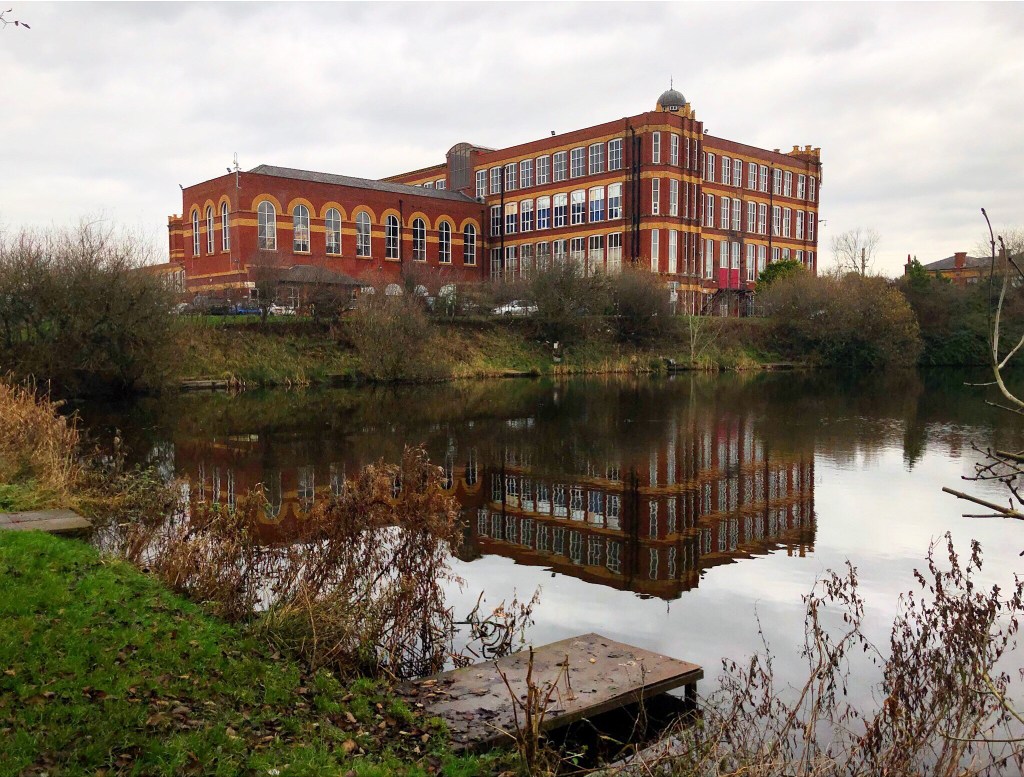
An example of this is Coppull Spinning Mill, fig.1, and its’ sister mill, Mavis Mill, in the village of Coppull. They were very decorative mills, most of the buildings made from terracotta bricks, with yellow bricks adding detail. Coppull used to be a predominately mining village but
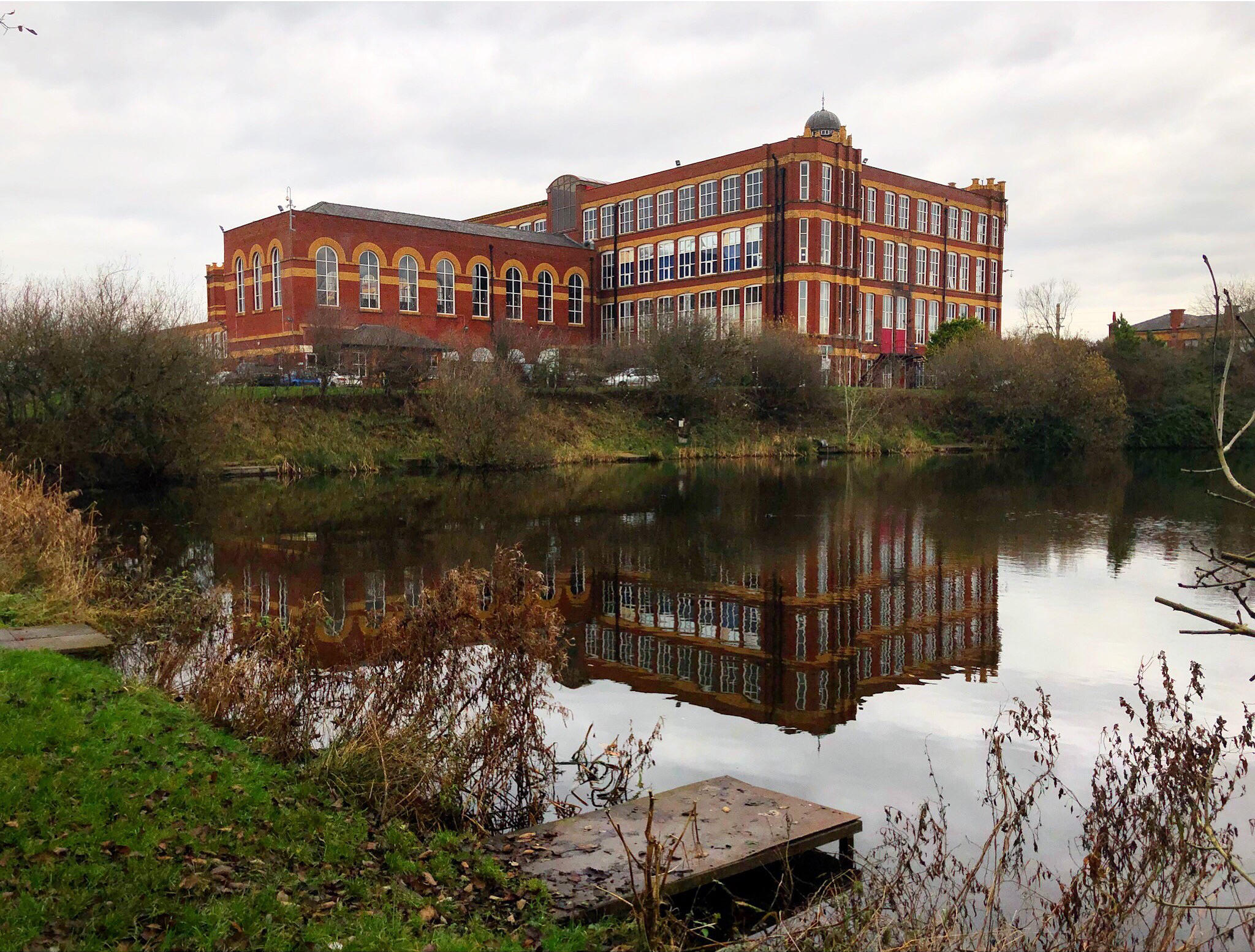
the industries began to branch out and factories for brick making, iron mongers and farms started appearing in Coppull. However, as industry started to decline, many of the factories and mills shut down and the huge, iconic buildings became relics of a once booming industrial village. This village still has a sense of pride in its industrial heritage with people sharing photographs of their families around the factories at the height of industry. Yet these buidings were able to decline in a similar fashion to the industries they housed. This may be because, as John Berger says in Ways of Being:
‘Gradually it became evident that an image could outlast what it repre- sented; it then showed how something…had once looked’
This may be the case for many industrial buildings, like those in the village of Coppull that the old pictures of the people smiling for pictures, in front of new, decorative buildings, are better to look at, and acknowledge, than the crumbling buildings which are empty and being taken over by nature and the now elderly people they know. This creates a knock on effect though, so these buildings get visited less and more get knocked down and the history they are seeing in pictures and enjoying, that could have been seen the whole time in person, is disappearing.
This large scale decline of architecturally intricate industrial buildings began
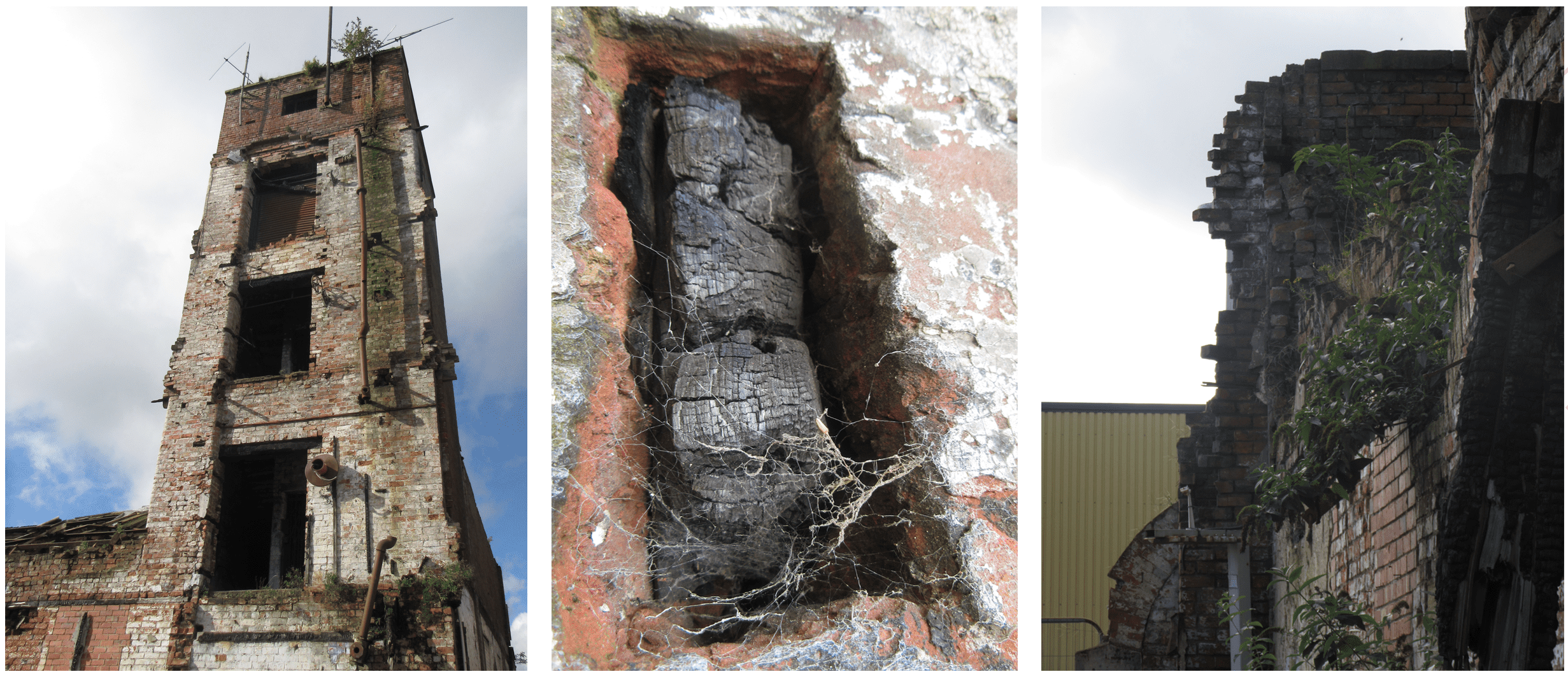
as soon as the mills and factories closed. Industrial Ruins (Edensor, 2005), explains the process of a building becoming a ruin and the perception of ruins. The industrial buildings are emptied of most equipment but a lot of things were usually left and after a short while they would be plundered and entry would be forced, causing the start of decay. According to Edensor, the homeless would start to inhabit disused factories which would lead to more decay along with the use of old industrial buildings as a recreational space. After time the process of decline to ruin becomes quicker as layers of rubble and mess form and weeds begin to crumble mortar so after the initial human damage has happened the elements begin to take to their toll. Hanover Street Mill shown in, fig.2, has evidence of this decay through weathering and a lot of the building has parts removed but rubbish and old tools left on the ground. These pictures show the weathering and
decay and the building isn’t used whilst the area surrounding is used as a car park.
This is often why many are torn down with some being left as relics and they
begin to become unnoticed by people. This is a stagnant stage of the buildings’
life as human interaction slows and some materials are left that have withstood the weathering but it is no longer an interest to people so it is left to nature. This could be seen as a similarity to a human’s life and in particular the ageing process. Over time a person becomes weaker and may become ill to a point when they may not be seen as getting any worse but they are being left and forgotten about like industrial ruins.
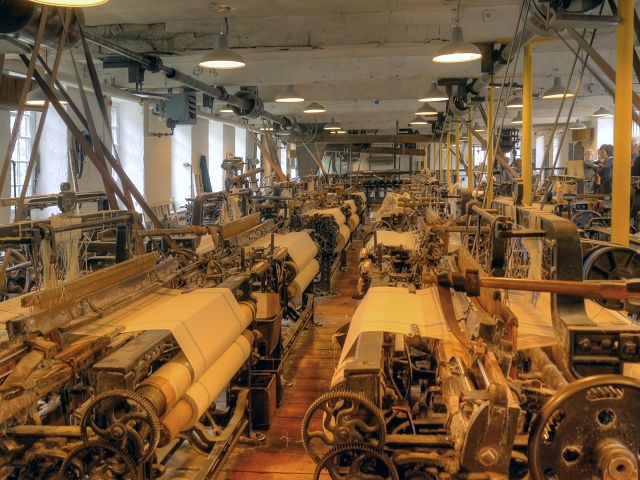
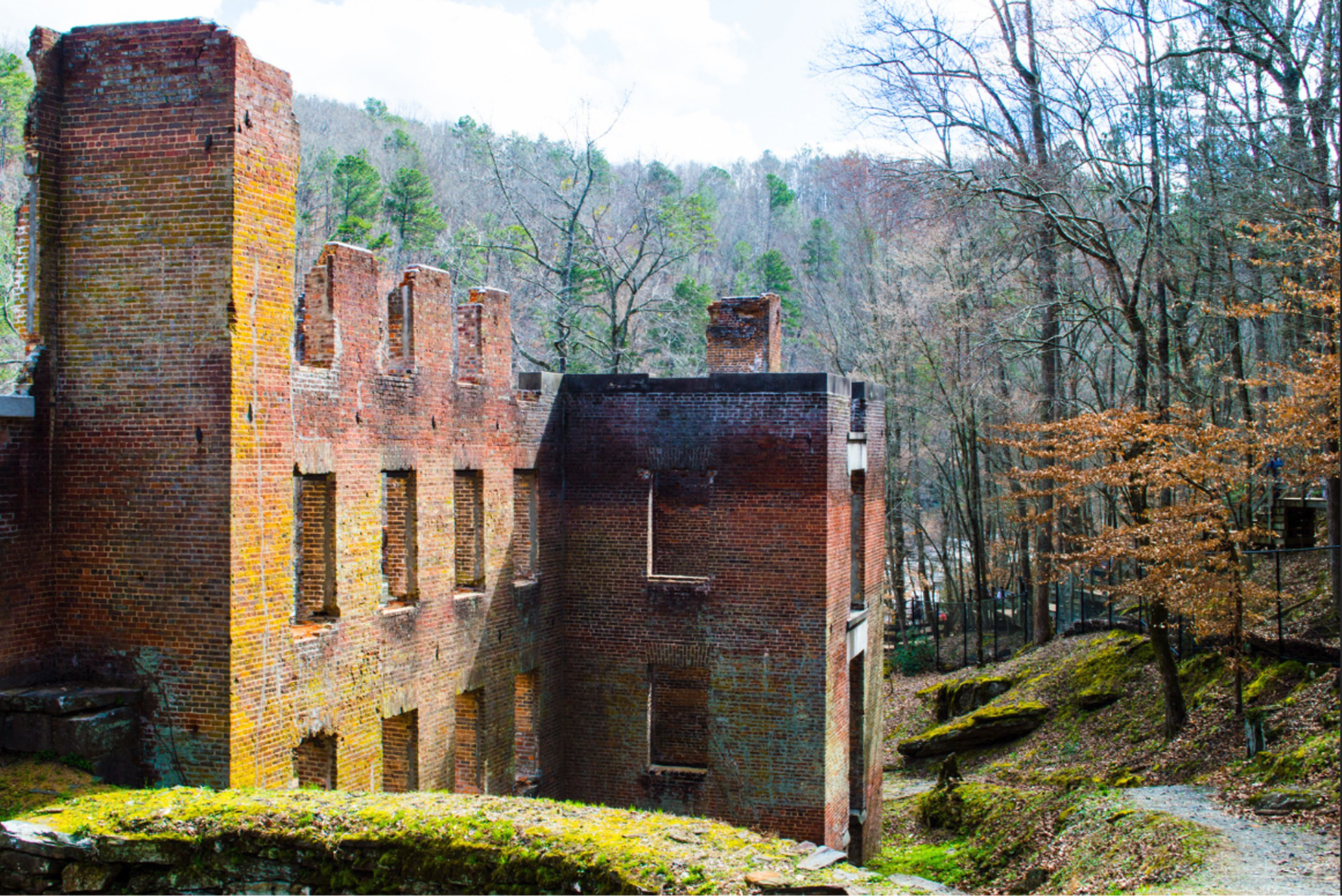
This did not happen with every industrial building after deindustrialisation, some aren’t ruins today but some, like Quarry Bank Mill (fig.3), have working machines.
A lot have been turned into apartments and retail spaces so although not their original uses they have been given a new purpose. Most of these repurposed industrial buildings have been altered quite significantly on the inside to fit the new needs of the space but they have kept original features and used the same industrial style to design the interiors. Quarry Bank Mill and Coppull Spinning Mill are both Grade-II listed as are many mills that are still standing today, giving hope that this history of industry remains and they don’t all become ruins.
The decline of industry caused many factories and mills to become ruins and shells of what they once were as they had a lack of purpose so weren’t used and reached
a point where they could not be brought back, just demolished. But those that are still standing and in use are protected and although are more successful in their repurposing they are still there to see for future generations rather than just a picture of them.
How the Decline of Industry Affected Communities and Current Issues around Loss and Absence.
Towns used to be built around mills and factories that created communities. It is
a growing problem that retired and disabled people in these communities are forgotten about or that mental health issues are overlooked. It is often the case that within these industrial communities, the problems are caused through industry and the loss of it. The older generations today are dealing with loss and absence of purpose similar to the loss that industrial buildings have gone through. The loss and absence humans endure is not solely due to deindustrialisation, but many workers obtained injuries that lead to disabilities including loss of hearing or limbs and would in turn make it difficult for them to find jobs.
A loss of a job can result in a lack of purpose and identity and this can bring isolation and an absence from a community. In a working environment, you gain another community and once this has gone it is harder to find a new community to be a part of. A lack of purpose can develop into depression and anxiety so it becomes
a downward spiral of more loss and absence. Although isolated, there are many people who feel this way and there are people who need more help and aren’t getting any
as these feelings are neglected particularly in older people (Dr.England, 2017). Although not solely due to deindustrialisation, the issues stem from similar places, loss of jobs, purpose and disability. These mental health issues can’t be seen by looking at someone and a loss is not visible, in the same way a memory can’t be seen but a photograph had a way of showing aspects of each of these when used in a certain way.
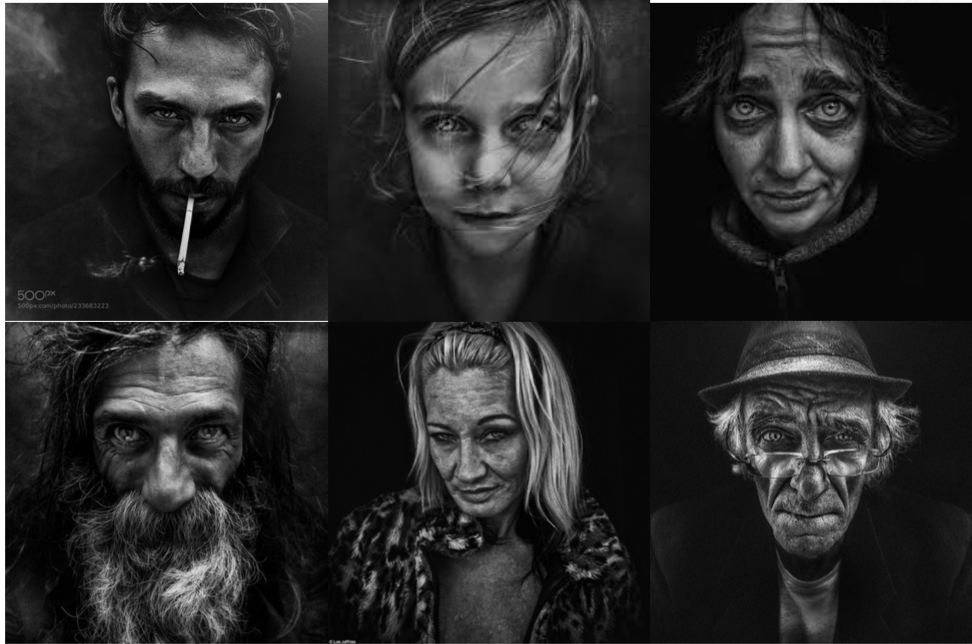
The mass loss of jobs, and therefore a loss of income, meant many people became homeless (Edensor, 2005, pg.25). Homelessness brings its own problems but there is a feeling of shame and isolation for the person who is now sleeping rough (homeless. org) and they become forgotten and part of a community that people choose to forget. They are seen as a whole group of people, and these people are seen as bad and given a stereotype even though each person has a different background and individual problems. Mental health problems can arise and as the people are forgotten about the illness goes untreated and gets worse, they are seen in a negative way and the drug and alcohol problems that some homeless people, not all, have overshadow the mental health issues. A collection of photos (fig.4) by a photographer named Lee Jeffries shows portraits of homeless people all taken and edited to the same style which focuses on the person and this highlights that when looked at individually every person is different but they are all seen in the same light and viewed as a singular group of the same people.
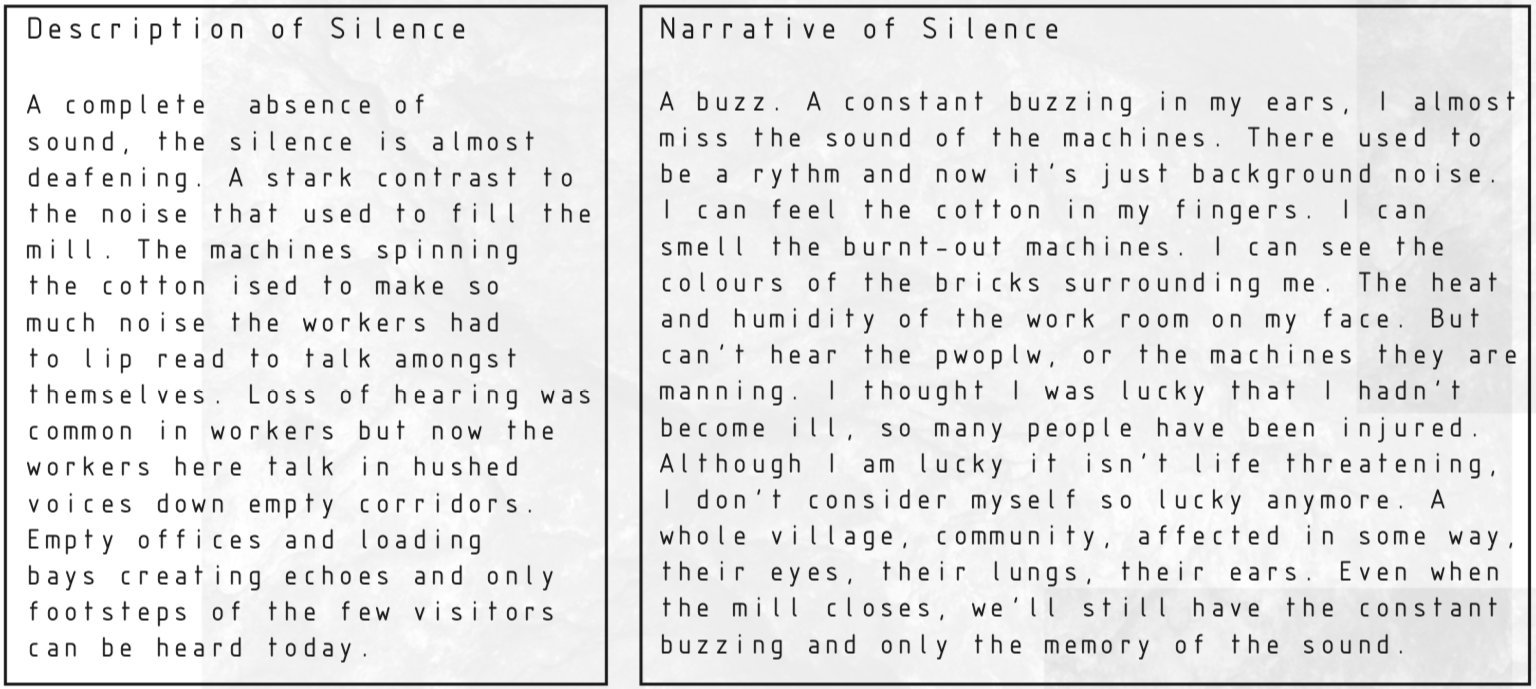
Silence is an absence of sound of this absence is often felt by people who once worked around industry. Fig.5 is the author’s text on silence and how it can be a narrative piece and a more methodological description. A passage from Industrial Ruins (Edensor, pg.149)
‘These embodied memories, forged through habituation to the rhythms of industrial discipline and the spatio-temporal imperatives of the working life, are not simply the imposed strictures upon the body by power, for such routines were also sensually inhabited. The chatter of the workplace, the constant whir of machinery, the songs sung together and all the other elements of the habitual soundscape forged a familiar backdrop to daily routine.’
Explains the level of noise that workers would have once been part of and from this they went to silence and quietness. Which for countless people would be relaxing and calm, but when this silence is paired with loss of purpose and community it can be very oppressing.
The Methods of Architectural Photography and What it portrays.
Architectural photography can show a lot about a building and its uses. Many photographers such as Bernd and Hilla Becher have documented industrial buildings
in a very systematic way to achieve a certain style. Often with photography of industrial buildings and ruins, it is what isn’t shown that makes biggest impact. This technique of absence in a picture is clear with the work of David Goldblatt who uses black and white images and the process of loss over a period to show industry decline. Architecture of Absence by Candida Hofer is an example of how showing buildings with no human activity where it should be creating an eerie feeling of loss and absence. The report will delve further into these techniques within this chapter to see why these photographs show absence so well.
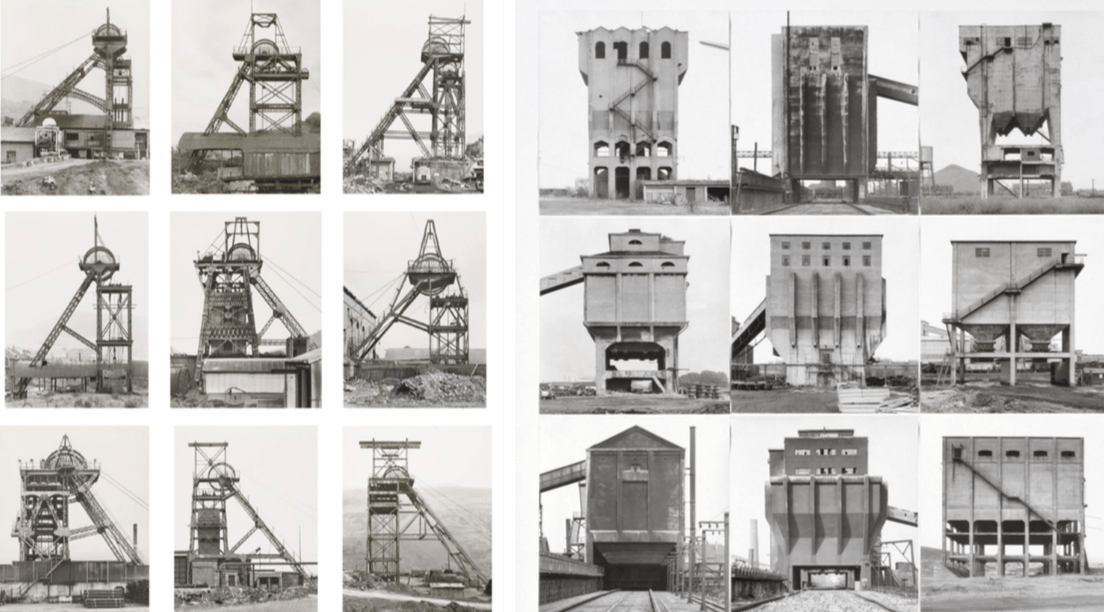
The Bechers and their work are arguably some of the most well-known and recognisable architectural photograph. Their Photographs (Fig.6) are all black and white and have the same layout with the building as the focus and the surrounding landscape has the same amount of land and sky to frame the building. This clear format for their work and this is very clear in their book Typologies, which when viewed as a collection makes the industrial buildings look very similar, and almost like a set of diagrams (Museum of Modern Art, 2008). However, each photograph is of a different building and the collection showcases a wide variety of industrial buildings and it’s the landscape of the picture that gives an individuality to each structure and is how the links to human characteristics begin (B.Stimson, 2004). The Photographs become social (D,Kuspit, 1990, pg.170) and could show links to social conformity and how each building should look but their landscapes show their history and as they are now ruins it could symbolise the weathering of materials, similarly to the problems people face and how it moulds them.
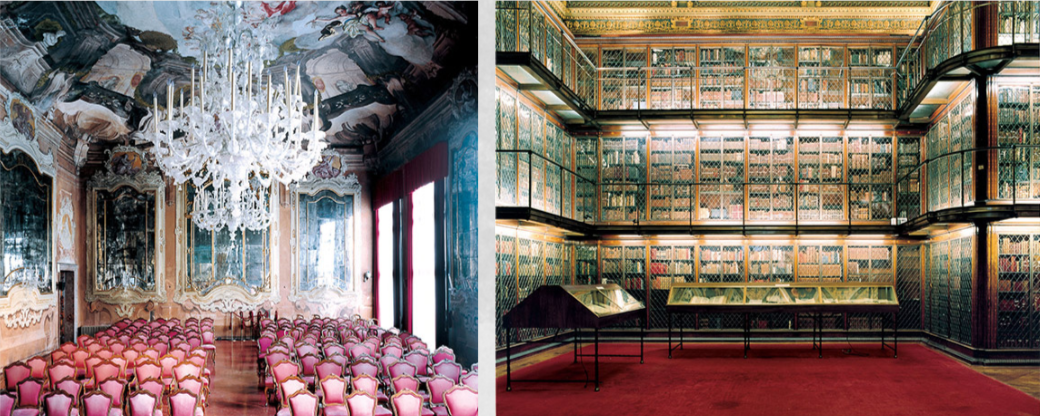
A student of the Becher’s, Candida Hofer, created Architecture of Absence which doesn’t follow as strict a methodology of photographic techniques but does show similar topics in her work. Hofer shows an absence through loss of purpose and it is made clear throughout the collection of photographs that this is what she is showing. Through lack of human presence in public buildings (fig.7), the pictures make the viewer feel slightly on edge as there is complete order, where there wouldn’t be if humans were present (FRYE, 2006). With no people in the pictures and everything in place, the observer can almost hear the silence and that gives a sense of loss as there is an absence, and in this instance, the absence is of sound.
In comparison to the absence shown in Hofer’s work, David Goldblatt shows a community in On the Mines. The pictures do show a loss but in a different way
than Hofer and the Bechers. This collection of pictures does show people in some photographs and uses colour and black and white images. What it shows is a community and a towns identity through industry. Goldblatt covers economy and society and
the photes are not taken as architectural photography. Architecture is shown but
in mainly black and whote with groups of people and they are taken from a distnce, giving a sense of being an outsider and looking ino this comunity which is a way
some people feel when they no longer work in industry with the people knoew. Viewers of the images can take different meanings from the intended, especially when seen separately or as a whole collection. There are specific photographs which when looked at individually can show loss and the decline of identity. Others show a community and piles of tools creatin he feeling like it had been deserted and the people are leaving.
The Loss Shown in Industrial Architectural Photography is a Metaphor for Loss in Communities Affected by Industrial Decline.
Through the analysis of architectural photography and exploring current issues within communities, a link has presented itself between the buildings and humans. The work of Bernd and Hilla shows a metaphor for loss and classification of people in society. As the photographs are a large collection this emulates the amount of people who have gone through loss, like the buildings have as they both lost their purpose and importance. During deindustrialisation people lost jobs and their identity and these people became a group of people that had once been part of a work community but now had been through a loss together. The photographs also show a group of buildings that once had a great significance where they stand but now are a collection of ruins. It is only when you take a close look at each building, or person, that you see the different locations and history. The similarities in how these buildings are perceived and how some people in society are viewed is seen most prominently when works by the Bechers is placed next to the work of Lee Jeffries in fig.8. The collections show a type of building/person, but each image is an individual with a different purpose and story. This shows industrial architectural photographs can be a metaphor for people and although the example given is of homeless people today, this was a repercussion of deindustrialisation. For the elder generations who have mental health issues this metaphor becomes more poignant as you can’t see their problems and are forgotten about, especially as other illnesses are seen as the bigger problems and mental health help is focused on younger people.
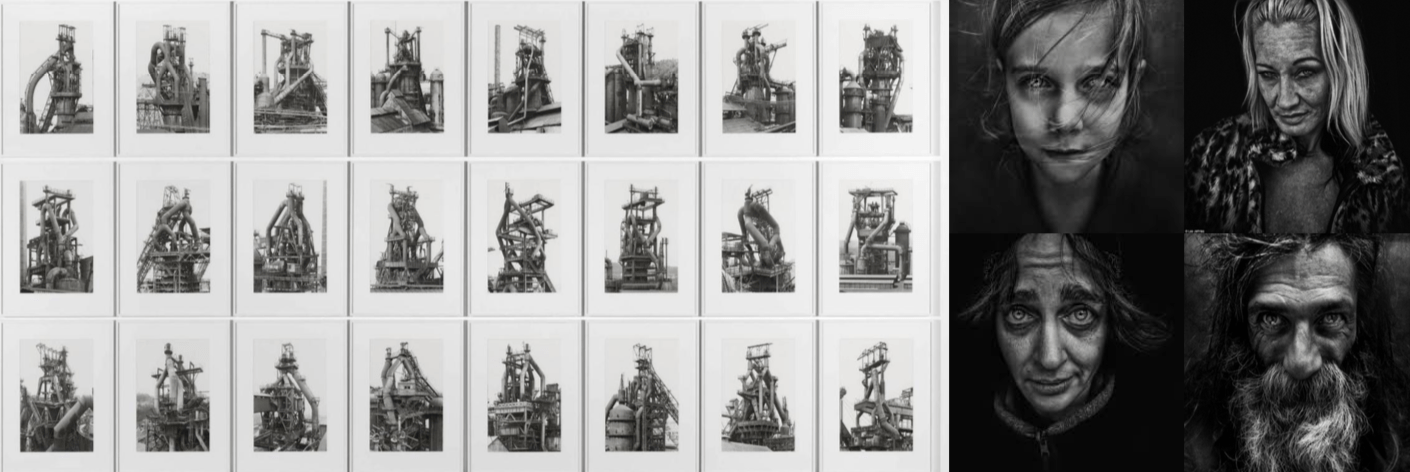
Industrial ruins are not seen for their history and importance in building towns and cities, in the same way as the people who worked in the buildings are forgotten about. Typologies show this in the way the landscapes are included and the parts that have been weathered in different ways and are what make the buildings different. The communities who once filled the buildings are also no longer present which is what would have made these buildings grow and develop and give it character beyond the bricks. Typologies and Architecure of Absence show the missing community and system of support for infrastructure and growth, completely mirroring the loss of support and friends as adults get older and come to terms with a loss of purpose. Therefore, these books are a direct metaphor for the loss of communities and support for older people who have been through loss of industry as a job and their work relations.
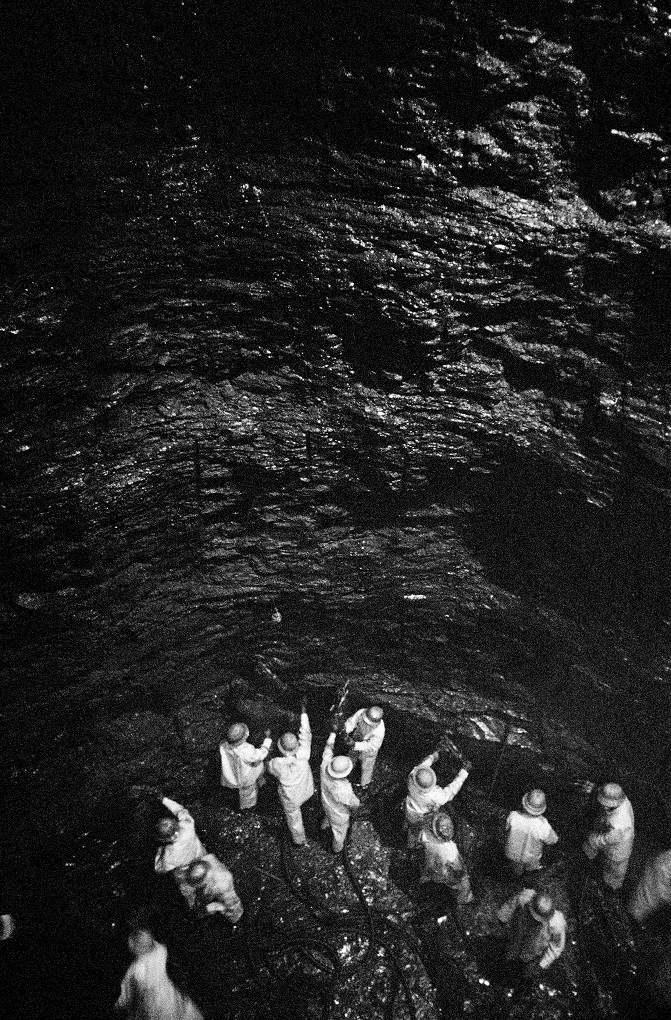
Identity and community is a large part of On the Mines by David Goldblatt which links directly to any industrial community and the loss of identity when the buildings and tools eventually become relics of a once booming town. As it can
also be a metaphor for things being hidden underground (J.Ladd, 2012) again like
how loss and absence isn’t something that is visible in people. Fig. 9 is an image that reflects this as it shows men in a dark hole, which may be being photographed but they are still solitary. It is as if people know they are in there but aren’t willing to join them, which is comparable to the figurative darkness that people feel they are in with mental illness. This image can be a direct metaphor but as a whole collection, along with Typologies, being in black and white it shows the darkness, oppression and lack of life that is associated with mental health.
The metaphor that is present shows a very current issue in today’s society and is therefore a necessary metaphor. The metaphor is created by a perception of an image and a memory that relates to it, which may be very different from the subject matter. Although this metaphor presents itself today, these images will be seen in five, 10, 50 years’ time by someone from a different culture and background and they will come up with a new meaning to these images. Berger explores how we have a different view of images from that of people from the past, we will never see the buildings how they were once pictured and know each story, and we see just ruins. This is comparable
to how we view the elderly as old and forget about them in society but they have memories of how they used to be.
Architectural Photography can be Manipulated and Perceived Differently by Individual Viewers and is a Great Tool to help Solve Current Issues.
An issue with photography is that it only captures a moment and can leave many details out. A photographer can have a reasoning behind their collection of pictures and other people who view the photo can have their own ideas for the photographers. The photographer could have taken the photos purely for aesthetics or to highlight an issue and the viewers have developed another meaning. This has happened with On the Mines by Goldblatt, he explains the metaphor of showing ‘what is hidden’ isn’t why he took the photographs but more because it is where he grew up and he wanted to show the importance of it (J.Ladd, 2012). There are no rules in what the viewer must see which means connections can be made that the photographer didn’t intend, which is why art is so powerful and can be used for metaphoric purposes. The memories and emotion the photographs evoke create these metaphors which in the case of this report is the industrial buildings becoming the portrayal of human issues.
There can be a sense of manipulation of views that comes with photography and a use of ‘negativity’ (M, Krivy) can create various ideas of what is not shown in pictures. Architecture of Absence (C.Hofer) is an example of this and the buildings she uses show no human presence but this could be because of the time of day or a closed off area. This does not invalidate the photographs but the context can change the meaning and if presented that way can remove the metaphor. Likewise, what text you surround
a picture with can alter the meaning and put an idea into the viewers mind (Berger, 1972). So by describing these images as a metaphor they clearly become that metaphor. This can also alter whether the metaphor becomes positive or negative as shown in fig.10 and fig.11 the building can either be seen as an old, disused ruin of a harsh, and difficult period in time or a part of a communities history and heritage that shows an identity of being part of the industrial revolution. It is the same image but the words surrounding make you view them differently. The level of pride varies with each image and this can have the same effect with how the metaphor is seen.
Whether the desired meaning shows through a photograph, the metaphors and images
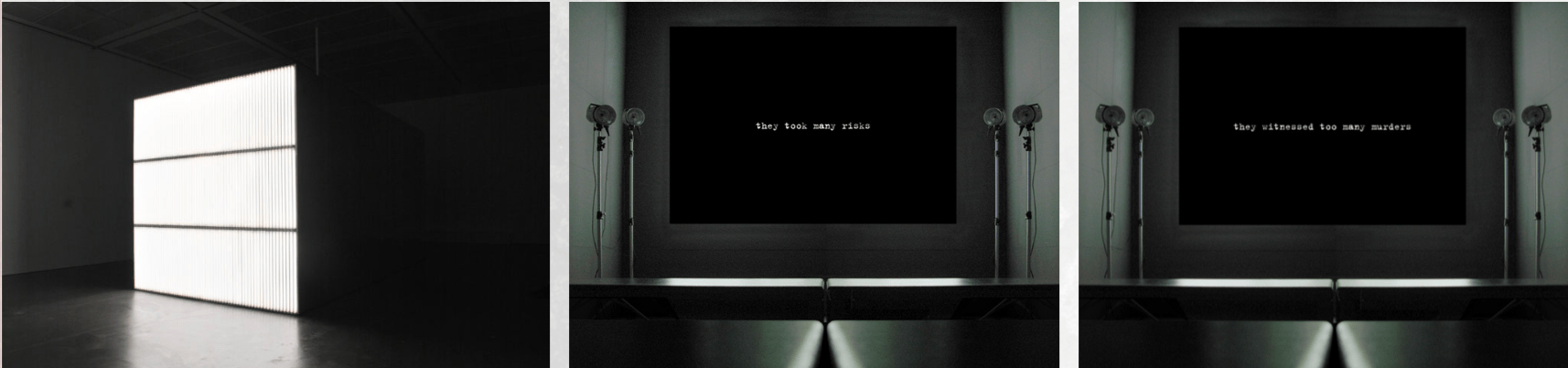
it can be portraying can be used to help make a change for current issues. An example of this, although not architectural photography, is The Vulture and the Little Girl fig. 12. This picture raised a lot of questions and won the Pulitzer prize but it made the viewer think about the whole situation, the photographer and the people who weren’t in shot. A photograph doesn’t always have words to explain the meaning and so you think more about the thought behind it and then the metaphors can be formed. They can be greatly useful in getting people to talk and in the case of Kevin Carters the Vulture and the Little Girl there were serious ‘moral debates’ (M. Geurts, 2015). This image was displayed as part of The Garden of Good and Evil at Yorkshire Sculpture Park by Alfredo Jaar and The Sound of Silence (fig.13) encapsulated the observer and heightened the senses, making the final image more shocking and confrontational and the silence and darkness made you more aware of yourself and your feelings (YSP, 2017). When used alongside design these types of photographs and the feelings they create can get the viewer to help solve current issues, even if they are locally, it starts a movement. Meaning that perhaps it is not the photograph itself but how it is displayed. Typologies by the Bernd and Hilla Becher would be less metaphorical of human loss and character if it was not as large a collection as it is. Nevertheless, an important message can be taken from a lot of architectural photography and when used effectively it can make people really evaluate their surroundings and how they see ‘ruins’.

Conclusion
Through exploration of the decline of industry and the effects it had on both architecture and humans themes and issues were acknowledged. Absence and loss are the main effects with loss of communities and the buildings becoming empty and silent. These feelings are very current issues with many people but in particular the older generation who are most forgotten about. This is the generation of people who built the towns and worked in industry and suffered loss of jobs, ability and community and who are also now seeing these important industrial buildings turning to ruins.
The theme of loss is also present in the photograph collections of Bernd and Hilla Becher, Candida Hofer and David Goldblatt. They show this through lack of colour and, for most, no human presence which evokes a feeling of emptiness and quietness as if the buildings are forgotten about. There is evidence of communities but they appear to be gone completely or leaving which begins the metaphor between the images and current human issues.
Industrial architectural photography can be viewed with varied meanings but this can be narrowed to it being a metaphor for loss and absence and the forgotten people within communities. Although meanings can change over time and be seen in a positive or negative light, this does not alter the current metaphor.
Therefore, the photography of industrial architecture shows the loss of identity and communities which is the effects on people caused by deindustrialisation, meaning it serves as a metaphor for current issues within communities.
 PORTFOLIO
Leave a comment